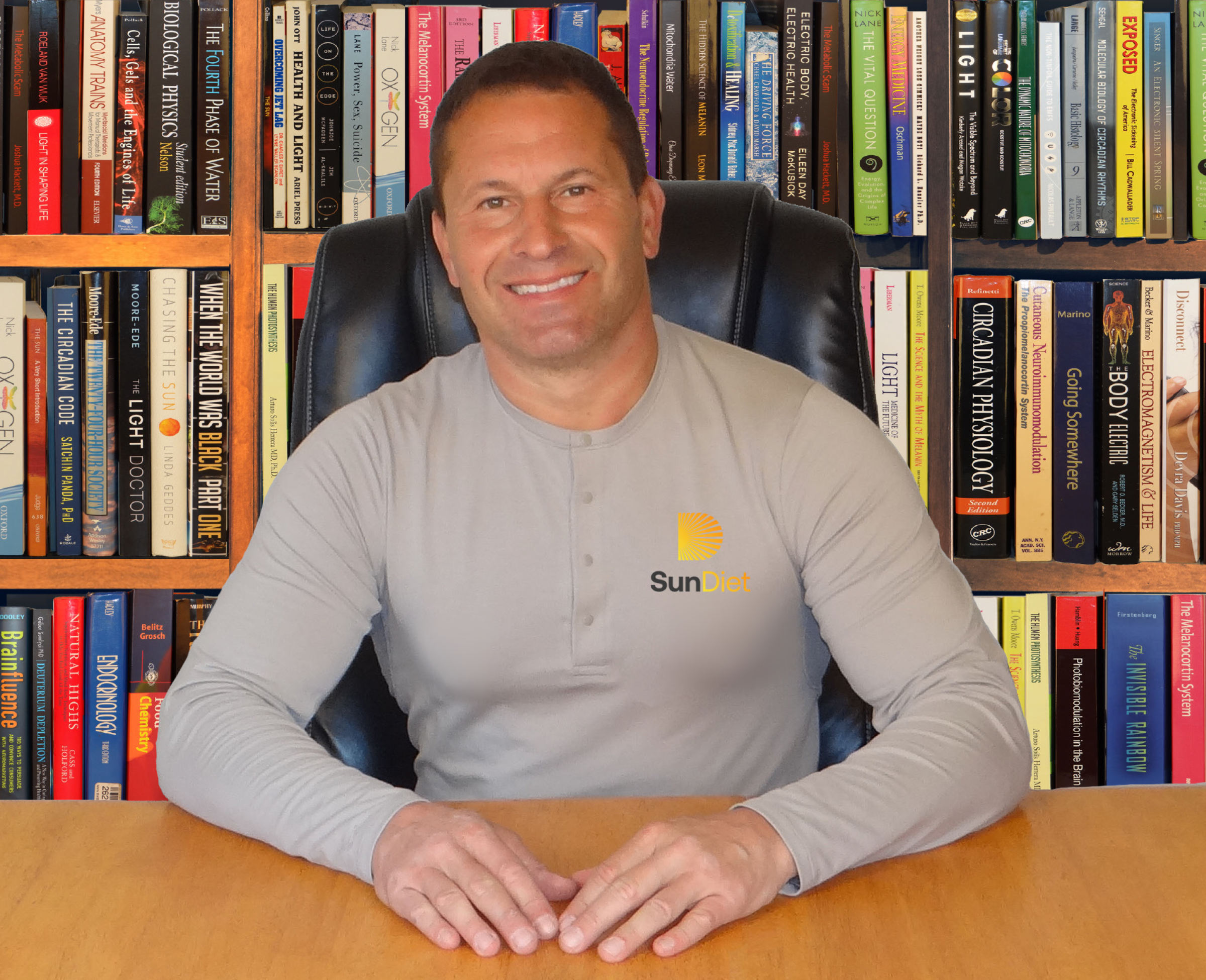
Witnessing my father's struggle with Multiple Sclerosis sparked my interest in nutrition. In our efforts to address his disease, we tried a variety of approaches, including healthy foods, targeted supplements, and cutting-edge medications prescribed by his doctor. Yet, none of these proved to be a solution. After he passed away, I realized there must be other underlying factors that are not being addressed.
Over the course of my career, I have independently published fifteen books focused on healthy eating and exercise. However, staying up late working on my computer—driven by a desire to help others—was not the best choice for my own longevity. The artificial light at night disrupted my circadian rhythm, resulting in poor sleep, intense food cravings, and a dependence on caffeine. Despite eating well and exercising daily, I also developed a blood clot in my left leg. Looking back, I realized I always carried my cell phone in my left pant pocket. Coincidence or not, I found myself—a 40-year-old fitness enthusiast—taking blood-thinner medication typically prescribed for older adults. For me, diet and exercise alone were not enough. There must be other, non-caloric factors contributing to dysfunction. People shouldn’t be experiencing serious health issues in their 30s and 40s as frequently as they do.
Rethinking the Fitness Paradigm
After years immersed in the fitness industry, where diet and exercise were treated as the foundation of health, I began to feel that something wasn't adding up.
Beneath the sculpted physiques and confident smiles of the Hamptons' elite trainers, I noticed another story unfolding. Bodies were breaking down. Energy was fading. Moods were fraying. Yet no one seemed willing to question the environment in which it was all happening.
The gym's polished image concealed a simple reality: trainers, much like physicians and other indoor professionals, spent most of their days under artificial light while the natural world remained just beyond the walls.
The disconnect became impossible for me to ignore when several trainers developed serious bone injuries within a relatively short period of time. One required shoulder surgery. Another, built like Adonis, fell off his bicycle while standing still and fractured his hip. A trainer tripped over a dumbbell and broke her wrist. Another suffered a broken ankle after a minor fall.
We are taught that strength training builds bone, improves resilience, and protects against osteoporosis.
So what was happening here?
Why were people who appeared exceptionally fit becoming so vulnerable to injury?
The more closely I looked, the more I began to question the conditions surrounding modern fitness. The environment itself seemed to contain overlooked stressors that few people considered. Clients passed through for an hour a day, but trainers lived in that environment for years.
Those observations set me on a different path.
Rather than simply walking away from the system, I set out to create an alternative. I developed the SunDiet™, a lifestyle program designed primarily for adults over fifty, including trainers, teachers, office workers, and others who had spent decades in demanding indoor environments. Its purpose was not to add more discipline, restrictions, or complexity, but to help people recover from the cumulative physiological cost of modern living by reconnecting with nature, sunlight, and the rhythms of the natural world.
Imagine dedicating your life to diet and exercise, only to one day realize that much of what you learned was incomplete—or even misleading. In my search for answers, I encountered the groundbreaking work of neurosurgeon Dr. Jack Kruse, which he discussed in a compelling interview with Rick Rubin and Andrew Huberman. Unlike most health professionals who focus primarily on biochemistry, his work emphasizes biophysics as the foundation. By recognizing how your biological rhythms align with your surroundings, you can uncover deeper insights into sustaining optimal health.
Circadian biology explores how your metabolism is influenced by the natural cycles of light and darkness. By aligning your daily habits with these rhythms, you can enhance brain function and support overall well-being. Effectively managing your circadian biology is crucial for maintaining health and longevity. In today’s modern world—where artificial light and wireless pollution are widespread —simply eating well and exercising is no longer enough.
Circadian biology has only recently been fully understood, so there’s no need to feel discouraged by our earlier misconceptions. For example, in the 1980s, the concept of the glycemic index was groundbreaking, measuring how quickly carbohydrates raise blood sugar levels. However, it wasn’t until 2016 that researchers began to recognize the “glycemic index” of light and its impact on our biology.
Research shows that artificial blue light can raise blood sugar levels, while exposure to red light can lower blood sugar by nearly 30%. This suggests that what passes through your eyes—your light environment —may have a greater impact on your metabolic health than what passes through your mouth.
I created the SunDiet™ to educate those unfamiliar with circadian science—a discipline that can take years to master independently. By aligning your body with the natural light and dark cycles, reducing exposure to unseen pollution, and eating properly, remarkable changes can occur. You will sleep more soundly, feel better, look younger, and think more clearly. The SunDiet™ emphasizes that many health problems originate from inadequate sun exposure, excessive use of technology, a weak magnetic field, and poor food choices, which together create dysfunction.
NUTRITION CERTIFICATIONS
Certified 40/30/30 Nutritionist, 1999
Certified Zone Diet Instructor, 2002
FITNESS CERTIFICATIONS
NASM (National Academy of Sports Medicine)
NFPT (National Federation of Professional Trainers)
FMS (Functional Movement Systems)
TRX (Suspension Training)
EXPERIENCE
Nutritionist for the Zone Diet Delivery Service -New York, Chicago, and Los Angeles
Dietetic Technician, Central Suffolk Hospital – Riverhead, N. Y.
Nutritionist and Trainer, Core Dynamics Gym – Water Mill, N.Y.
Nutrition consulting, Ross School Tennis Academy – East Hampton, N.Y.
Nutrition consulting, West Hampton Hurricanes football team
Director of the Parisi Speed School, Setauket, N.Y.
Special guest Nutritionist on “The Culinary Experience” with chef Michael Mosolino
Guest lecturer at the Fight Breast Cancer for Women at South Hampton High School
CURRENT FOCUS
My current focus is to investigate the non‑calorie forces that affect our health, beyond the familiar prescriptions of diet and exercise.